Author Archives: NDrockclub

Unknown's avatar

About NDrockclub

Central Dakota Gem & Mineral Society, based out of Bismarck, ND. Local rock club.

CDG&MS Library

This is an ongoing project – more will be added after the existing library is removed from the club trailer.  Below is a link to the books in the Club Library.  These are housed at the Heritage Center, and are available to be checked out M-F, 8am-4:30pm.  Please contact Becky Barnes first, to make sure she is in the building (ndrockclub@gmail.com), 701-328-1954.

Any club member in good standing (all dues paid) may check out a book.  We are restricting this because books have walked away in the past.

https://docs.google.com/spreadsheets/d/1TOHUov3VXIobrA__84oNfoAh6BdsTYnyAuHyuQfDwAo/edit?usp=sharing

I believe at this time the check-out time is a month.  Many of these books are out of print – if a checked out book is damaged beyond repair, it is suggested the member make a donation to the club treasury to buy a comparable book.
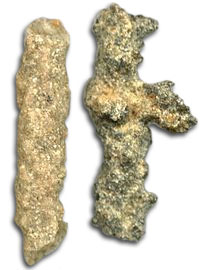
Fulgurite

fulguriteNot truly a mineral or a fossil, fulgurite is sometimes referred to as petrified lightning. The word comes from Latin (fulgur = lightning), and is amorphous “lechatelierite” silica glass. When lightning or electricity strikes a conductive surface, the temperature can skyrocket to at least 2,950F and melt surrounding silica or quartz leaving behind a glass tube. Lechatelierite can also be formed when a meteor impacts the ground, or during volcanic explosions.

They vary in shape, size, and color, and can be very fragile. Larger pieces have been recorded between 13-30 feet in length. Their shape mimics the path the electrical charge took.

https://en.wikipedia.org/wiki/Fulgurite

http://geology.utah.gov/map-pub/survey-notes/glad-you-asked/what-are-fulgurites-and-where-can-they-be-found/

Campeloma

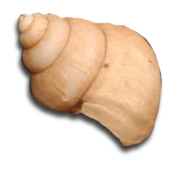
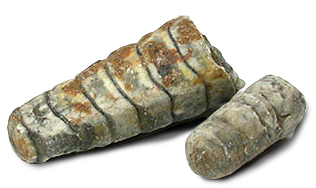
campeloma 1Campeloma are common freshwater snails, with an ancestry dating back to the Cretaceous of North Dakota. These gastropods (“stomach foot”) can be found at times with other snail genus, mainly Viviparus or Lioplacodes. Campeloma shells tend to be bulbous, with highly convex body whorls – the spirals that make up the shell, and about an inch long. Viviparus are about the same size as Campeloma, but the whorls are nearly flat on the outside, giving the shell a smooth cone appearance. Lioplacodes has bulbous whorls like Campeloma, but the overall cone-shape of the shell is much more pointy (like a stubby unicorn horn). Like their modern counterparts, these snails most likely lived between 3-11 years. They had a varied diet, including carrion and vegetation.campeloma 2

Septarian nodule (concretion)

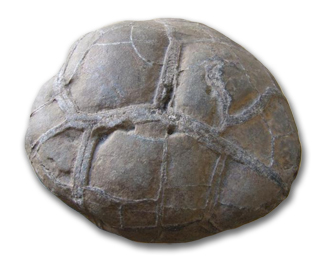
External, weathered surface of a septarian nodule.

External, weathered surface of a septarian nodule.

A “concretion” refers to a type of mineral deposit, where layers of precipitated minerals are attracted to a starting nucleus (such as shell or bone) – much like how a pearl forms. Generally this occurs in water-rich environment, where there are minimal restrictions or obstructions to the concretion growth, resulting in a round shape. Numerous concretions may start growing near each other, then merge to form larger masses.

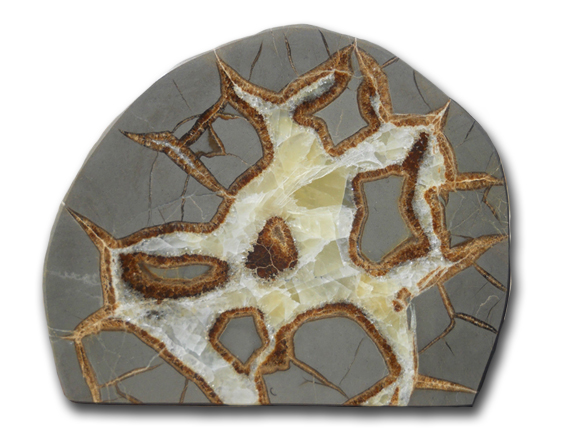
These particular concretions contain angular cracks and cavities. The word “septarian” comes from the Latin word septum, meaning a wall or partition, referring to the cracks riddling through these concretions. It is believed the cracks are formed from shrinkage of material – where the outside deposited material is denser or hard, while the innermost material is softer, which shrinks and cracks over time. These cracks are then filled with precipitate minerals such as calcite or siderite.

Internal polished surface of septarian nodule, showing calcite and iron-rich deposits.

Internal polished surface of septarian nodule, showing calcite and iron-rich deposits.

Septarian nodules are common in the northeastern part of North Dakota, near the Pembina Gorge. As they weather out of the ground, the softer, original concretionary material erodes faster than the cracks, giving the nodule a turtle-shell like appearance. These are often mistaken for fossils.


http://en.wikipedia.org/wiki/Concretion

Buchanan, Rex C., Tolsted, Laura L., and Swineford, Ada, 1986, Kansas Rocks and Minerals: Kansas Geological Survey, Educational Series 2, 60 p.

Quartz

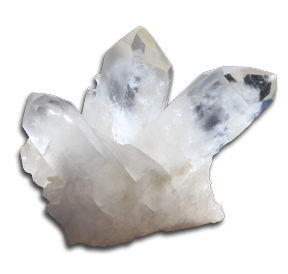
quartz 1Quartz is a very common mineral, with numerous shapes and colors. For as long as people have enjoyed shiny things, quartz has been used in jewelry and carvings. Different types of quartz include: chalcedony (white, lightly colored), agate (multi-colored, banded), onyx (agate with straight, consistent bands), jasper (red-brown), aventurine (chalcedony with shimmering inclusions), tiger’s eye (gold to red-brown), amethyst (purple), citrine (yellow to orange), prasiolite (light green), rose (pink), smoky (brown to gray), carnelian (red-orange), and others. The biggest difference in forms is whether the mineral is macrocrystalline (showing individual crystals), or microcrystalline (tiny crystals, visible under magnification). Transparent varieties showing good crystal forms such as amethyst or citrine would be macrocrystalline.

Quartz can be found as a component of many other rocks and minerals – granites, sandstone, and schist, for example. Crystals are generally six-sided, but commonly twin. It is a 7 on the Mohs scale, with a white streak. The chemical formula for quartz is SiO2 . As the second most common mineral found on earth (the most common being feldspar), quartz can be found world-wide.

It is piezoelectric – meaning it generates an electrical charge if put under stress. It is used as an oscillator in radios, watches, gauges, etc. Quartz sand is used to make glass, as well as a sandblasting abrasive.

http://www.mindat.org/min-3337.html

http://www.minerals.net/mineral/quartz.aspx

http://en.wikipedia.org/wiki/Quartz

Orthoceras

External shell

External shell

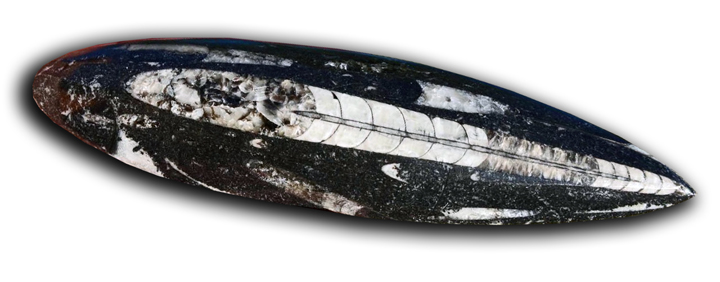
Orthoceras (meaning “straight horn”) is an extinct animal related to squid and octopus. Unlike tasty calamari, their shells (being in the phylum mollusca) are on the outside of their bodies, instead of the pen-bone or gladius seen today. They are often mistaken for another straight-shelled cephalopod, Baculites, however lived much earlier during the Ordovician through Triassic (488-190 mya), rather than the Cretaceous (145-65 mya). Limestone deposits containing mass die-offs of Orthoceras are common in Morocco. The ones from this location tend to be white in color, with a black background – often used in decorative carvings, bowls, and even countertops.

Their straight shells are divided horizontally by “septa”, which separate living chambers of the

animal. When it grew too large for one chamber, it would add on another. A tube running through the length of the shell, called a “siphuncle”, helped regulate water and air in the shell, allowing for both movement and buoyancy. They vary in size, from tiny centimeter long shells, to more than 6 feet long (more, if you add the tentacles!).

Polished Orthoceras, showing siphuncle and septae.

Polished Orthoceras, showing siphuncle and septae.

http://en.wikipedia.org/wiki/Orthoceras

http://www.fossils-facts-and-finds.com/orthoceras.html

Galena

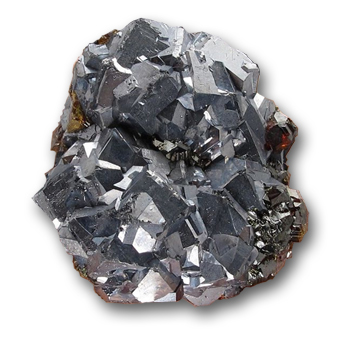
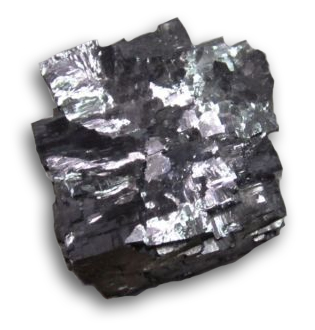
galena2Galena, a lead sulfide, is not only a source of lead, but of silver as well. Metal extraction is simplified by its low melting point. It is dark grey-silver in color, with an octahedral crystal structure. The metal surface can tarnish when exposed to air, darkening the color. It was named in 77AD by Pliny the Elder, from Greek “galene”, literally meaning lead ore.

Deposits can be found in England, Bulgaria, Australia, the USA, and many North African countries, among others. It is the State Mineral of Missouri and Wisconsin.

This mineral is used, and has been used, for a variety of applications. From kohl in ancient Egypt, lead shot, green glazes for pottery, and crystal radio sets. It has a variety of common names, such as “blue lead ore”, and “potter’s ore”.galena1

The chemical formula for Galena is PbS, and it has a hardness of 2.5-3 on the Mohs scale. Being mainly lead, it feels very heavy when held. Its specific gravity is 7.4-7.6, whereas pure lead is 11.3. Pyrite, an iron sulfide, has a specific gravity of 4.9-5.2.

http://en.wikipedia.org/wiki/Galena

http://www.mindat.org/min-1641.html

http://www.minerals.net/mineral/galena.aspx

Palache, Charles, Harry Berman & Clifford Frondel (1944), The System of Mineralogy of James Dwight Dana and Edward Salisbury Dana Yale University 1837-1892, Volume I: Elements, Sulfides, Sulfosalts, Oxides. John Wiley and Sons, Inc., New York. 7th edition, revised and enlarged, 834pp.: 200-204.

Amethyst

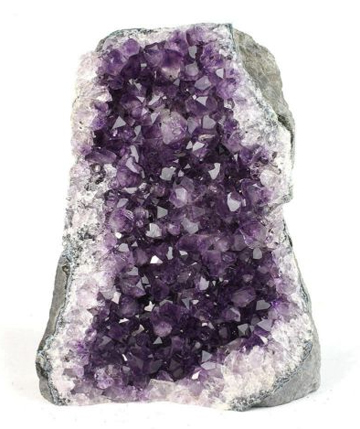
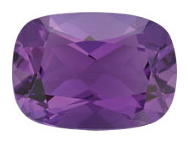
amethyst2Amethyst is a purple variant of quartz (yellow = citrine, green = prasiolite), with its color coming from iron impurities. Its name comes from the Greek “a-“ (not) and “methystos” (intoxicated), stemming from the belief that the stone protected against intoxication. It was also thought that the stone would make a person more clear-headed. Amethyst can be found world-wide, with large deposits found in Brazil, South Korea, Austria, Russia, and numerous other countries. Before large deposits were found, this stone used to be lumped with diamonds, rubies, and sapphires for its rarity and preciousness. With a hardness of 7 on the Mohs scale, it makes a good gemstone – fortunate, as it is the birthstone for February. Cutting the stone properly can be challenging. The crystals do not often have a uniform concentration of color, but vary in shades of purple and mauve. These crystals are often found in geodes – some of which are massive in size.amethyst1

Chemical Formula: SiO2

Kunz, George F. The Curious Lore of Precious Stones. New York City: Halcyon House, Blue Ribbon, 1930. Print.

http://www.mindat.org/min-198.html

http://www.gemdat.org/gem-198.html

http://www.gemstone.org/index.php?option=com_content&view=article&id=98:sapphire&catid=1:gem-by-gem&Itemid=14

Amazonite

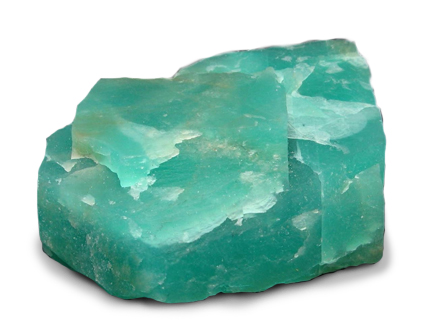
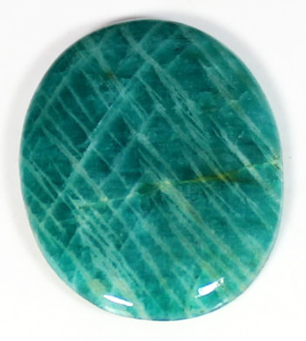
amazonite 2Amazonite, also called amazonstone, is a type of microcline feldspar which is translucent to opaque blue-green in color. It was named in 1847 by Johann Friedrich August Breithaupt. Even though the name implies a locality close to the Amazon, no deposits have yet been found nearby. Instead, it has been found in Ontario, Quebec, Italy, Russia, and Colorado. The color comes from traces of lead, not copper.

If used as a gemstone, it is generally cut into a cabochon due to its fragile nature. It has a hardness of 6-6.5 on the Mohs scale. The chemical formula for Amazonite is KAlSi3O8.amazonite 1

http://www.britannica.com/EBchecked/topic/18797/amazonstone

http://www.mindat.org/min-184.html

http://www.gemdat.org/gem-184.html

Teredo-bored Petrified Wood

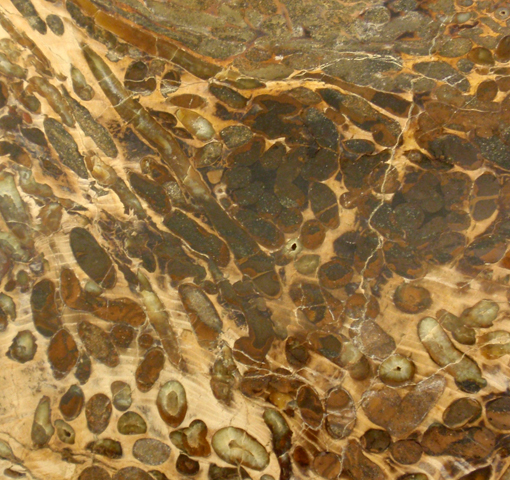
Teredo borings with woodgrain

Teredo borings with woodgrain

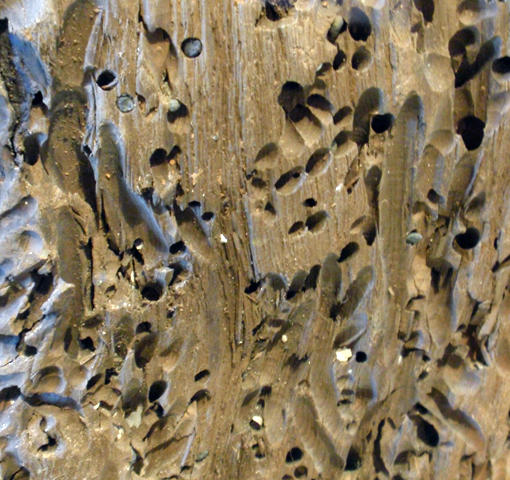
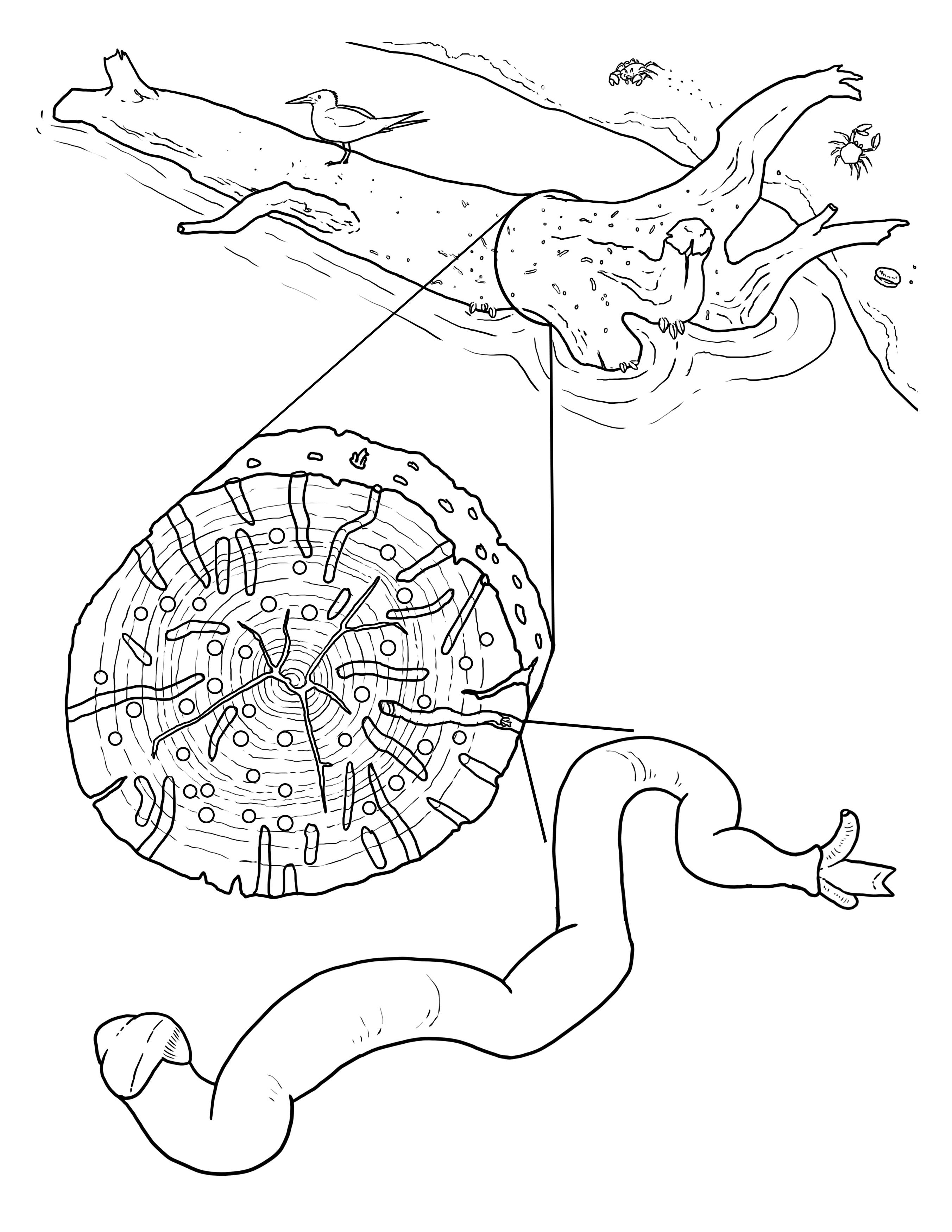
Teredo-bored petrified wood is North Dakota’s state fossil. It is found in 60 million year old Paleocene deposits, found in the southwestern area of the state. These are areas that were covered by the Cannonball Sea, now exposed at the surface. Before fossilizing, it was drift wood (ginkgo, bald cypress, metasequoia, etc.) that had been drilled (bored) into by small worm-like clams (Teredo), creating a Swiss-cheese effect.

Modern day example

Modern day example

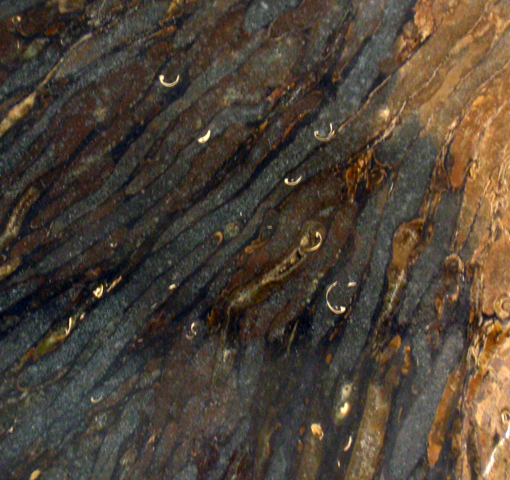
Part of the fossilization included filling the borings with sediment or crystals, often seen as a different color or texture. If slabbed, the tiny clams can even be seen in cross section as little white crescents. The clams, also called shipworms, still pose a problem for wooden boats or docks today.

Borings with Teredo cross-sections

Borings with Teredo cross-sections

Teredo-bored petrified wood was adopted in 1967, and added to the Smithsonian Institution’s mineral collection. The selection was brought to the legislature by R. W. Carlson of Bismarck, former present of the Central Dakota Gem and Mineral Society, and H. A. Brady of Mandan. State Represenative W. G. Sanstead of Minot proposed the state fossil selection in House Bill 933.

Magnification of Teredo

Magnification of Teredo

https://www.dmr.nd.gov/ndgs/outofprint/NewsLetters/1993Spring.pdf (publication page 4 & 5)

http://ndstudies.gov/state_fossil

https://www.dmr.nd.gov/ndfossil/kids/FIND%20ISSUE%2011%20small.pdf