Tag Archives: stone

Swedish Blue

Fall of 2023 we made the trek up to Minot, ND, to visit the Nordic HostFest. While wandering around we came across a silversmith booth that specialized in “Swedish Blue”.  Not knowing anything about this “stone” I took a closer look.  They had raw samples for sale in a basket – and I foolishly didn’t purchase any – as well as numerous beautiful cabochons worked up in silver bezel mountings.  The stone looked like a silicate, with conchoidal fracturing similar to what you might see with opal, and was streaked with varying shades of sky or stormy blues.  I purchased a pendant and earrings, then later visited their website to learn more.

I highly suggest reading more about the silversmiths and stones on their page:  https://www.swedishbluejewelry.com/

The trade name or gemstone name for the stone is “Swedish Blue” – especially for us English speakers that may have difficulties with Nordic dialects.  However the name for the raw stone in Swedish is called “Bergslaggsten” – or stone from Bergslagen. 

Beginning over 300 years ago in Sweden, the area of Bergslagen was mined heavily for iron ore.  The ore was smelted in coal-fired ovens where the ore and surrounding rock was melted.  When it reached a high enough temperature, a slag glaze would form at the top, which was scraped off of the metal and discarded.  The slag comes in many colors, but the higher concentration of blues is what set this particular stone apart. 

I was correct in my initial guess that it was high in silica – it is very glass-like, with copper giving it much of the blue-green colors.  Much like volcanic glass, but from an iron foundry.  The slag was discarded, and eventually grown over with local vegetation – only to be found by a Swedish goldsmith centuries later.

Malachite

malachite3

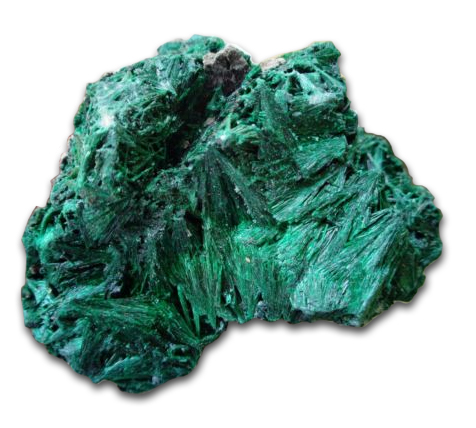
Fibrous malachite

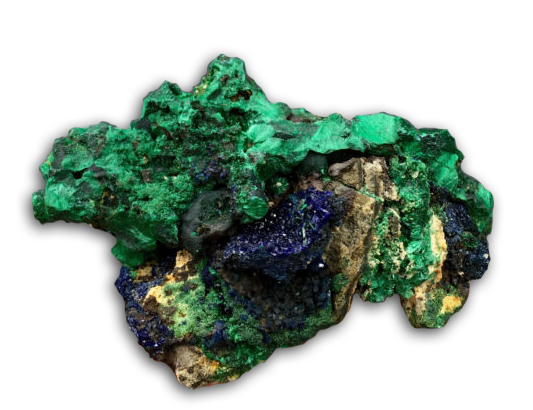
Malachite is an intense green colored, copper carbonate mineral. Instead of being a solid color, it is often banded in shades of green. While it can form tabular and twinned crystals, it is more often seen as botryoidal masses, or stalactitic, with a fibrous banded structure or crusts. Malachite can commonly be found with azurite. It has a hardness of 3.5-4 – soft enough to carve readily, yet still taking a polish. The stone is used for decoration, ornamentation, and jewelry. It can also be crushed and made into a green pigment. It was originally worn to ward off evil spirits.

Malachite comes from many locations, including Russia, Africa, Australia,

malachite2

Malachite with azurite

Brazil, and Arizona. It was named after the Greek word “mallows”, alluding to its leafy green color. It has also been called Atlas ore and Green Copper.

The chemical formula is: Cu2CO3(OH)2


http://www.minerals.net/mineral/malachite.aspx

http://www.mindat.org/min-2550.html

Pellant, Chris. Rocks and Minerals. New York: Dorling Kindersley, 1992. Print. Pg. 105.

Busbey, Arthur Bresnahan. Rocks & Fossils. Alexandria, VA: Time Life, 1996. Print. Pg. 174

Amazonite

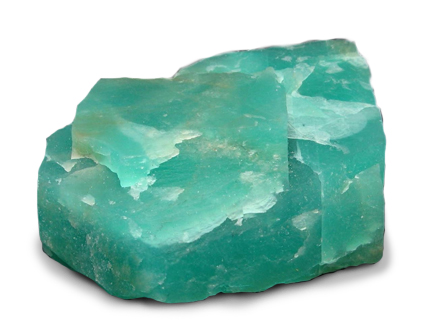
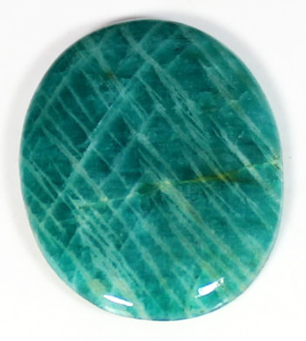
amazonite 2Amazonite, also called amazonstone, is a type of microcline feldspar which is translucent to opaque blue-green in color. It was named in 1847 by Johann Friedrich August Breithaupt. Even though the name implies a locality close to the Amazon, no deposits have yet been found nearby. Instead, it has been found in Ontario, Quebec, Italy, Russia, and Colorado. The color comes from traces of lead, not copper.

If used as a gemstone, it is generally cut into a cabochon due to its fragile nature. It has a hardness of 6-6.5 on the Mohs scale. The chemical formula for Amazonite is KAlSi3O8.amazonite 1

http://www.britannica.com/EBchecked/topic/18797/amazonstone

http://www.mindat.org/min-184.html

http://www.gemdat.org/gem-184.html

Tanzanite

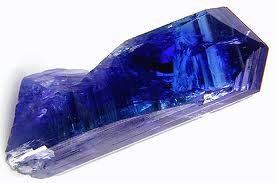
Tanzanite crystal

Tanzanite crystal

Tanzanite

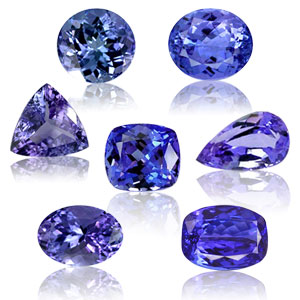
Discovered in 1967 in Tanzania, tanzanite (named by Tiffany & Co.) is one of the more recent birthstones for December (as of 2002, via the American Gem Trade Association).  While the stone may be light violet in some cases, darker shades of periwinkle with hints of purple are sought after for higher gem quality.  A blue variety of the gemstone zoisite, tanzanite has a Mohs harness of 6.5-7 – not particularly tough for a gemstone.  Corundum (rubies and sapphires) sit at a healthy 9.0 on the Mohs scale.

Tanzanite, faceted

Tanzanite, faceted

The blue color is caused by trace amounts of vanadium within the ziosite – much like trace elements can also cause various colors of diamonds.  The blue can be enhanced and brought out in the stone by careful addition of heat.  Tanzanite crystals are also pleochroic – meaning from different angles they exhibit different colors.  The same crystal from one direction may look blue, and another direction look red or brown – thus faceting the stone can be challenging.

The chemical composition of tanzanite is:  Ca2Al3(SiO4)3(OH)

References:

Newman, Renee.  Exotic Gems: How to Identify and Buy Tanzanite, Ammolite, Rhodochrosite, Zultanite, Moonstone & Other Feldspars.  International Jewelry Publications, 2010.

http://www.jtv.com/library/tanzanite-gemopedia.html

http://www.minerals.net/gemstone/tanzanite_gemstone.aspx

http://www.gia.edu/tanzanite-quality-factor